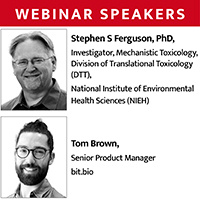
In this webinar hosted by DDW and supported by bit.bio, Dr Stephen Ferguson, Investigator, Mechanistic Toxicology, Division of Translational Toxicology (DTT), National Institute of Environmental Health Sciences, will explore the complexities of in vitro modelling for human liver toxicity and pharmacology. He will discuss the development and implementation of advanced cell systems mimicking liver functionality and their responses to various chemical exposures, including PFAS and botanical mixtures. Dr Ferguson will shed light on the principles guiding effective models, the common pitfalls encountered in research, and the promising advancements being made in this vital field of environmental health.
Tom Brown, Senior Product Manager at bit.bio, will present a new liver research toolkit featuring human iPSC-derived hepatocytes deterministically programmed with opti-ox™ technology, offering solutions for advancing disease modelling and drug discovery and representing a potential alternative to primary human hepatocytes and immortalised cell lines.
What you will learn:
- How to develop cell systems that replicate liver functionality to better predict human responses to toxic substances.
- The effects of diverse xenobiotics, including PFAS and other environmental chemicals, on liver health.
- Key principles in modelling, challenges faced in the field, and progress made towards improving toxicological assessments.
- The role of deterministically programmed human iPSC-derived hepatocytes as potential alternatives to primary hepatocytes and cell lines.
An audience Q&A session with the speakers follows the webinar presentations.
Watch the webinar on-demand now!