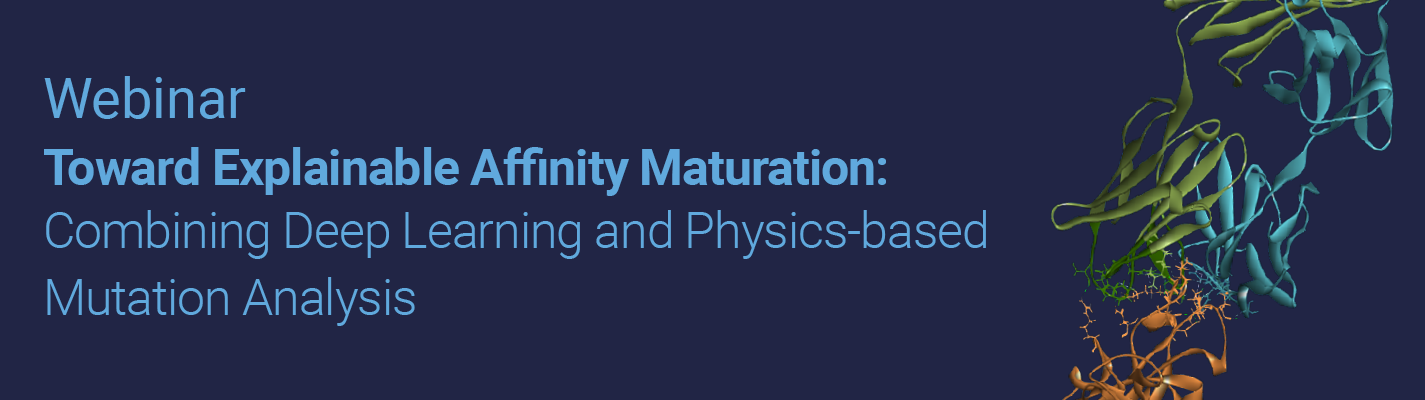
This webinar, hosted by DDW, explores how deep learning and physics-based methods can be combined to improve antibody affinity maturation and epitope mapping using workflows available in BIOVIA Discovery Studio Simulation on the 3DEXPERIENCE cloud platform.
Through case studies involving antibody-antigen and nanobody-receptor complexes, the work demonstrates how virtual mutagenesis, molecular docking, molecular dynamics simulations, and mutation energy calculations can predict the impact of single and multiple mutations on both binding affinity and protein stability.
The presentation compares traditional physics-based approaches with emerging AI-driven methods, including AlphaFold-based co-folding models and inverse-folding deep learning tools such as AntiFold, highlighting both their potential and current limitations for predicting flexible antibody interactions and stabilising mutations.
Benchmarking against free energy perturbation (FEP) methods further shows that Discovery Studio Simulation mutation energy protocols can achieve strong predictive performance while enabling much higher throughput for large-scale mutagenesis studies.
 Overall, the work illustrates that by integrating physics-based modelling and AI methods into a unified platform, Discovery Studio Simulation provides an efficient environment for antibody engineering and biologics optimisation.
Register for free and watch the webinar on-demand now!
Supported by